Four engines, one company.
Path 1 is the core — the hockey stick growth and recurring revenue VCs price on. Paths 2–4 accelerate it. Tap any section to drill down.
VCs at the seed stage want exactly two things: a hockey-stick growth curve and recurring revenue. Everything on this page exists to produce those two numbers by January 2027. Path 1 is what produces them. Paths 2–4 make them bigger and faster.
What's on this page
Reactivate the existing base — the hockey stick
Produces: hockey-stick growth + recurring revenue — the two things VCs price on
Six million people downloaded the Groups app portfolio. About a million left an email address. 38,000 devices are active in the last twelve months. Five named projects are already live. This is not a cold start. The audience exists. The $1M funds reactivating it and building the automated sales funnel that converts them into paying customers.
The existing audience Real
Appfigures dashboard — the proof
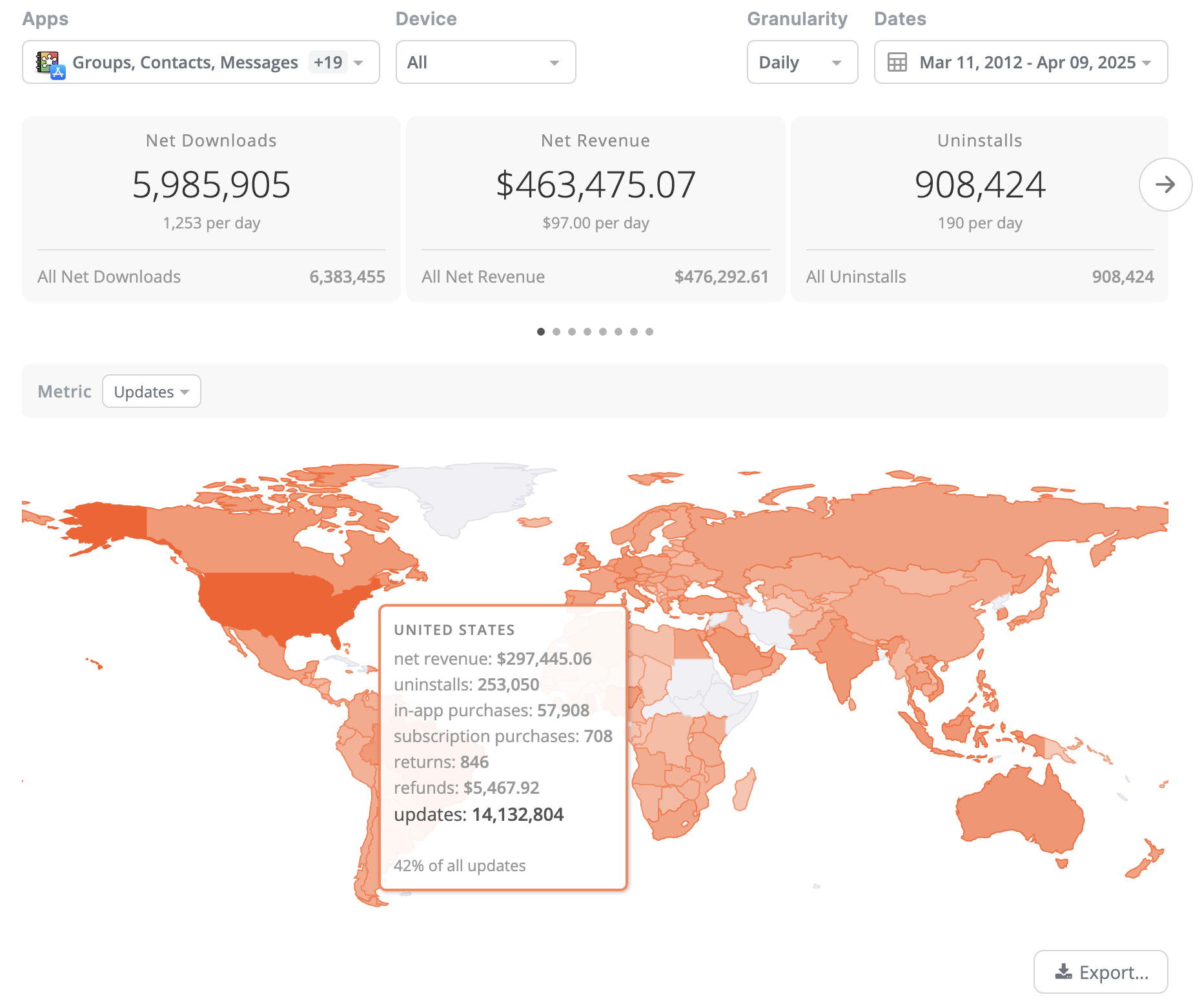
Five named projects already live: unaligned.club (Scoble), markedge.org (Edge), caroline.vote (Shinkle), Free Cities, Work AI.
The automated sales funnel
The funnel works like every freemium SaaS that locks in through usage rather than contracts:
Step 1 — See it (push, email, YouTube, influencer post)
A push notification costs nothing and lands on their lock screen. "Your community now has an AI assistant." Email waves start with the most recently active, expand outward. Not a sales pitch — a newsletter showing what Safebots can do for their community.
Step 2 — Try it free for a few months
One click. They get a branded app and AI bots for their community. No credit card. No setup. Their members start joining. Usage begins.
Step 3 — Members build history (the lock-in)
Onboarding, events, introductions, messaging, content. Every interaction makes the system more useful and harder to leave. The members' data, relationships, and workflow memory create the switching cost.
Step 4 — Members pay for membership
The leader charges their members for access to the community, content, and bots. Revenue starts flowing through the platform. The leader is now earning.
Step 5 — Free tier ends, paid tier begins
After the free period, the leader pays a weekly fee for compute, storage, and bot capacity. But their members are already paying for membership — so the cost is covered. The leader's revenue exceeds their Safebots bill. Cancelling means telling their members to go somewhere else.
Projected milestones — the hockey stick
| Metric | Jan 2027 3 mo · VC round | Jun 2027 | Sep 2027 | Mar 2028 18 mo · Series A |
|---|---|---|---|---|
| End users | 2,000 | 25,000 | 200,000 | 1,000,000 |
| Activated leaders | 80 | 800 | 5,000 | 15,000 |
| Paying customers | 5 | 60 | 500 | 2,000 |
| Trained operators | 8 | 40 | 200 | 500 |
| Live Safeboxes | 40 | 200 | 1,000 | 2,500 |
| MRR | $5K | $40K | $350K | $1.8M |
| $SAFEBUX volume/mo | $2K | $30K | $300K | $1.5M |
Where the hockey stick comes from. Each activated community leader brings 50–200 members. That multiplier is what turns 1,000 leaders into 25,000 users by January and 15,000 leaders into a million users by the Series A. The Groups app did this seven million times.
Why the conversion is nearly automatic
By the time the free period ends, the leader has members on the platform, relationships built, content published, and workflows running. Leaving means telling their members to go somewhere else and losing the history. The free period is not a trial. It is the onboarding that makes cancellation impractical.
Influencers & content engine
Produces: new community leaders into the Path 1 funnel, brand awareness, YouTube distribution
YouTube and paid distribution
A managed social-growth partner (Viral Coach or similar) produces 2–3 searchable videos per week. The AI safety news cycle gives us fresh material constantly.
Paid crypto influencer distribution through agencies like AAudience — packages from $4,900 (10 channels, 5 languages) up to $88,500 (top crypto influencers). Run starter packs, measure conversion, scale what works.
Influencers as customers, not sponsors
We build influencers their own membership site — their brand, their domain, their audience, their revenue. Powered by Safebots. They promote it to their own audience. The audience joins. We earn on the compute.
They tell that audience: "I have a new site. It's powered by Safebots. You can have one too." Each influencer is a free distribution channel for life.
Already live Confirmed
Robert Scoble — unaligned.club. AI founders, technologists, investors. Has interviewed Elon Musk and Mark Zuckerberg.
Mark Edge — markedge.org. Libertarians, crypto early adopters, radio audiences.
Caroline Shinkle — caroline.vote. Manhattan professionals, donors, civic groups. Author of the SOLE Act.
The operator course — audience becomes infrastructure
People who see influencer sites → some start their own community → some take the operator course and run Safeboxes themselves. Course graduates deploy Safeboxes, onboard customers, earn on usage. Each operator is a node in the network and a local sales force in their own geography.
Enterprise / SecurityScorecard / CISO channel
Produces: large contracts, real ARR, enterprise credibility
Alex Yampolskiy and the mentorship Confirmed
Alex Yampolskiy (CEO of SecurityScorecard) and his cofounder invest a smaller amount and take an advisory/mentorship role. We work out of their office. Alex mentors on enterprise sales, positioning, and closing CISOs. By December the product is buttoned up and demo-ready for enterprise buyers.
Art Basel Miami · December 2026 Invited
Alex is hosting CISOs from 30+ companies at Art Basel. We present Safebox directly to this audience — pre-qualified by their relationship with SecurityScorecard, in an informal setting where deals get started over conversation. If even three meetings turn into pipeline, that's $150K–$1.5M in potential contracts.
The CISO pipeline — remediation product
SecurityScorecard scores companies on security posture and increasingly detects AI agent governance deficiencies — but they have no remediation product. Safebox becomes the recommended fix. The buyer is already motivated — their security score depends on it.
Enterprise deployments: $50K–$500K per contract. A single Fortune 500 CISO saying yes is more ARR than a thousand community leaders.
Investor intros from Alex and cofounder
Their investor network from building SecurityScorecard opens doors to VCs for the seed round. BoldStart, GV, Sequoia, Evolution Equity — all SecurityScorecard investors, all reachable through warm intros.
Hire a high-profile startup CEO
Produces: capital, credibility, institutional access
Who we're looking for Searching
A recently departed executive from a frontier AI lab — someone who left OpenAI, Anthropic, or DeepMind over concerns about open-ended AI agents. They see Safebots as the architecture that could meaningfully address the problem they walked away from.
This person comes in not for the salary but because the thesis is urgent. Equity from the option pool, vesting with a cliff.
How we find them
Robert Scoble makes the introductions — he's interviewed everyone from Zuckerberg to Musk. His network includes AI executives, safety researchers, and former lab leaders. CEO search starts immediately. First conversations within weeks.
What they unlock once hired
A CEO with frontier-lab credibility walks into Sequoia, Founders Fund, a16z, and YC with a story no other AI safety startup has: "I left because the big labs won't solve this. I found the team that will." They open the $20M seed round and every round after it.
Why they run in parallel
Each path covers the others' weaknesses and feeds their strengths.
Combined timeline
Pre-seed closes at $4M. $1M in. All four engines start.
Sales funnel and reactivation start. Push notifications to 38K devices. Email waves to the million. Automated funnel goes live.
Content engine starts. YouTube production, influencer outreach, first operator course cohort.
Product buttoned up for enterprise. Alex and cofounder invest. Work from their office. CISO-ready demo prepared.
CEO search begins. Scoble makes introductions. First conversations within weeks.
Present to 30+ CISOs at Alex's event. First enterprise pipeline from a single room.
2,000 users, 80 leaders, 5 paying, $5K MRR. Growth curve visible. First $SAFEBUX volume on the network.
$4M at $20M. Three slides: growth curve, enterprise pipeline, team. Round fills behind the lead.
25,000 users, 800 leaders, 60 paying, $40K MRR. Operators in multiple geographies.
First enterprise contracts close. $50K–$500K each. Real ARR from enterprise alongside consumer growth.
200,000 users, 5,000 leaders, 500 paying, $350K MRR.
$15M at $80M. 1M users, $1.8M MRR consumer + enterprise. Secondary window for early investors.
Three companies that grew this way
OpenClaw · zero to 100K GitHub stars in two months
Open-source AI agent harness. Alex Finn was the #2 influencer by YouTube engagement. 300,000+ GitHub stars by mid-March, surpassing React's ten-year total. Adoption built on YouTube and X, not enterprise sales.
Cursor · $1M → $4B ARR in three years, bottom-up
$20/month AI code editor. YouTube tutorials drove adoption. Enterprise was 25% at $400M ARR, 60% at $2B ARR. Valuation: $400M → $29.3B in fifteen months. Individuals brought it to teams, teams brought it to companies.
Midjourney · $500M ARR, zero VC, zero marketing
Discord bot. YouTube drives 41% of traffic. $500M revenue by 2025 with ~40 employees. $4.7M revenue per employee — higher than Google or Meta. Enterprise licensing came years after consumers built a $500M business.