Consumer first.
Enterprise follows.
The product is built. The infrastructure is live. The patents are filed. We are raising $1M to go to market.
ChatGPT did not start with enterprise procurement. It started with a free chatbot that hit 100 million users in two months. Microsoft invested $10 billion that same month — priced on the growth curve, not on enterprise contracts. Perplexity started as a consumer search tool, now valued at $22.6 billion. Cursor started as a code editor individual developers paid $20 a month for, now valued at $60 billion. Consumer adoption created the valuation. Enterprise revenue came after.
Crypto followed the same pattern. Bitcoin was retail for eight years before the ETF. Ethereum grew because developers built apps and users bought Ether to use them. By the time institutions showed up, the price had already moved by orders of magnitude. If that story is yours, the full parallel to Safebox, Safebots and $SAFEBUX is further down this page.
None of them won by having a better product and waiting. OpenAI burned through billions in compute subsidies to make ChatGPT free. Perplexity raised $300M before it had meaningful revenue. Cursor raised $900M in under four years. The product got them noticed. The capital got them to scale. A better mousetrap sitting in a garage does not become a movement.
That is why we are raising. The product is built. The $1M buys three things:
By customers
Community leaders, agencies, influencers — people who sign up, deploy their app and bots, and start running their communities on the platform.
To end users
Each customer brings their members. One leader brings a hundred people. A thousand leaders bring a hundred thousand. The members interact with bots, build history, and create the lock-in.
By next investors
Adoption and distribution produce the growth curve VCs price the next round on. $4M today. $10M in January. $50M at the Series A. Each round priced on the metrics the previous round's capital produced.
The $1M also funds listing $SAFEBUX on exchanges and marketing the token to the same audience we are already reaching. A million community leaders around the world, and the people who follow them — we help them run their communities, and they buy $SAFEBUX on exchanges or directly through us to pay for compute, storage and bot capacity. That purchasing creates real demand. Investors who staked their $SAFE tokens earn yields from that demand. Meanwhile the equity valuation grows through the adoption metrics above. Two engines running at the same time: token cashflow for stakers, equity appreciation for everyone.
The distribution assets are real — a million emails, 38K push-reachable devices, five named projects already live. What the capital buys is the marketing, the operator training, the content engine, and the reactivation campaigns that turn those assets into the growth curve the next investor prices on.
Projected milestones
What the numbers look like at each checkpoint.
These are targets, not commitments. They assume the $1M pre-seed closes in September 2026 and gives us an eighteen-month runway. The first three months are about getting real — product live, first operators trained, first leaders reactivated, first projects generating content. The compounding starts at month four and accelerates through the Series A at month eighteen.
| Metric | Jan 2027 3 mo · VC round | Jun 2027 6 months | Sep 2027 12 months | Mar 2028 18 mo · Series A |
|---|---|---|---|---|
| People using Safebotsend users — community members, attendees, contacts | 2,000 | 25,000 | 200,000 | 1,000,000 |
| Activated community leadersfrom the 1M email list + 38K active devices | 80 | 800 | 5,000 | 15,000 |
| Paying customersleaders, agencies and orgs on a paid tier | 5 | 60 | 500 | 2,000 |
| Trained operatorscourse graduates running Safeboxes | 8 | 40 | 200 | 500 |
| Live Safeboxesdeployed nodes — run by us or by operators | 40 | 200 | 1,000 | 2,500 |
| $SAFEBUX monthly volumecompute + storage paid for on the network | $2K | $30K | $300K | $1.5M |
| Monthly recurring revenuesubscriptions + usage + course tuition | $5K | $40K | $350K | $1.8M |
| Named projects liveShinkle, Scoble, Edge, Free Cities, GBA, etc. | 3 | 5 | 8 | 12+ |
The product works and people use it
2,000 users, 5 paying customers, 8 trained operators, three named projects live, first $SAFEBUX volume on the network. Early but real — enough to open the round and let the next three months of compounding close it.
The network is real and growing
A million users, 2,000 paying customers, 500 operators, $1.8M MRR, $1.5M monthly $SAFEBUX volume. Recurring revenue, retention, network density, and evidence that Safebox is becoming a standard.
We say so early
If activation rates on the email list come in below 0.1% or operator graduation-to-deployment falls below 50%, we know by month three and adjust the plan before the VC round opens.
The plan, bottom up
Step by step, starting with what we already have.
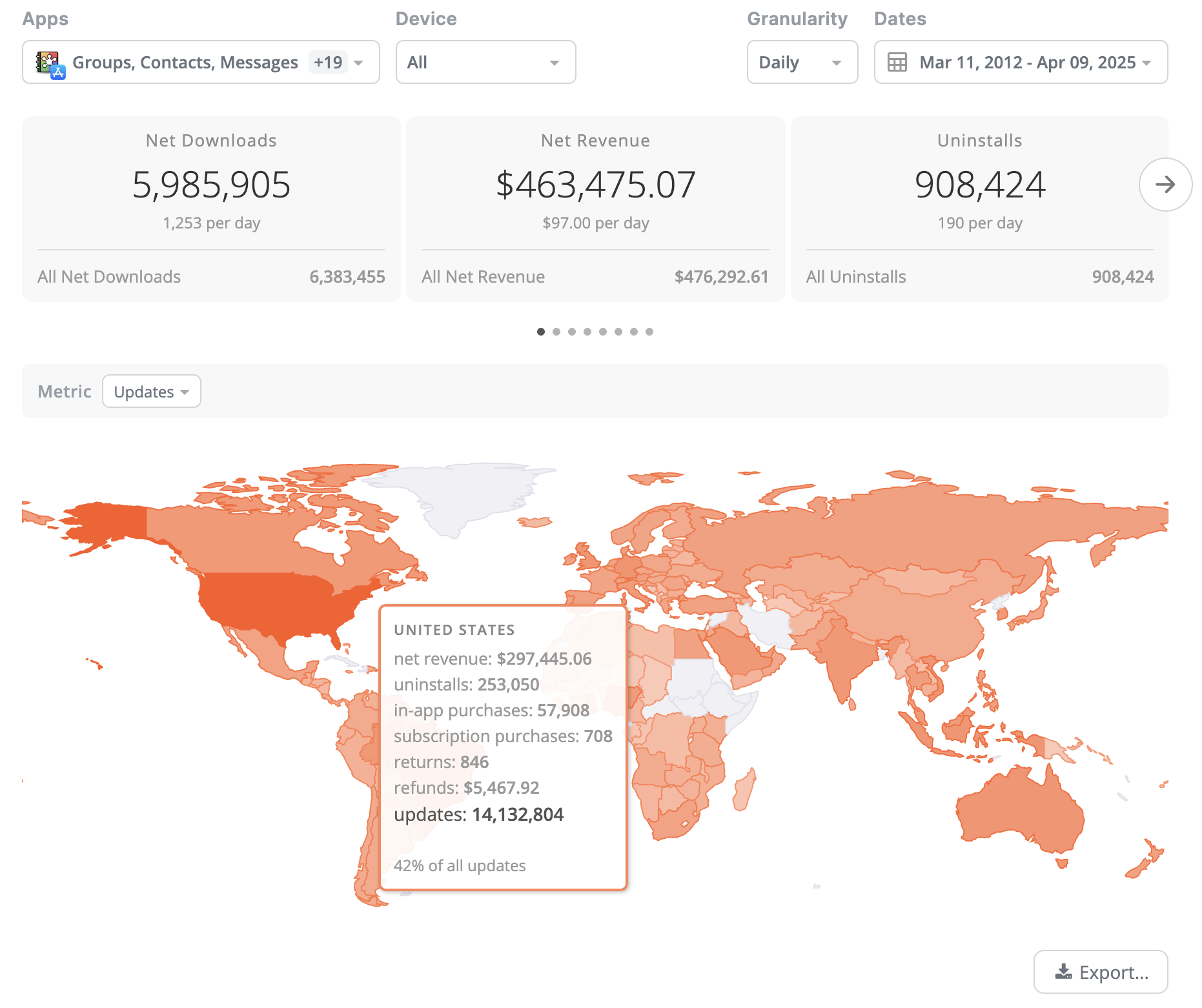
Six million people downloaded the Groups app portfolio. About a million left an email address. 38,000 devices are active in the last twelve months — those users still have the app installed and accept push notifications. Every time we push an update, hundreds of thousands of users receive it. We start here.
Push to the 38K active devices
A push notification costs nothing and lands on their lock screen. "Your community now has an AI assistant. Tap to try it." These people already know us.
Email the million, in waves
Start with the most recently active, then expand outward. Not a sales pitch — a newsletter showing what Safebots can do for their community. Warm the list incrementally, segment by country and language.
App updates reach hundreds of thousands
Every update to Groups reaches the installed base. The U.S. alone generated 14 million app updates. Each update is an opportunity to introduce Safebots inside an app they already use.
Two channels for video. The first is a managed social-growth partner like Viral Coach and the Shane Hummus model — high-volume, searchable content that solves expensive problems for a narrow audience, with a direct call to action into a demo or signup. One video becomes transcripts, clips and posts. The AI safety news cycle gives us fresh material every few weeks.
The second is paid crypto influencer distribution through agencies like AAudience, which packages YouTube channels by region, language, format and audience size. Example inventory from their October 2025 sheet:
| Package | Channels | Reach | Cost | Turnaround |
|---|---|---|---|---|
| International Starter | 10 channels | English, Russian, Filipino, Hindi, Arabic | $4,900 | 4–5 days |
| High Quality CPV | 5 channels | English, 125K–13K subs each | $13,750 | 1 week |
| Europe Region | 7 channels | French, German, Spanish, Italian, Greek, Portuguese | $10,590 | 1 week |
| LATAM Region | 6 channels | Portuguese, Spanish | $6,700 | 1 week |
| ASEAN Region | 6 channels | Indonesian, Vietnamese, Filipino | $7,050 | 1 week |
| AMA / Interview | 4 channels | UP NEXT CRYPTO (1M subs), DataDash (511K) | $29,990 | 2–4 weeks |
| Top Crypto Influencers | 5 channels | Boxmining (562K), Altcoin Buzz (453K), Coinsider (316K) | $88,500 | 1–2 weeks |
We do not need to buy all of these. The International Starter at $4,900 gets ten channels in five languages with a one-week turnaround. Run it, measure signups and activation, and scale what converts. The entire inventory across all packages totals about $170K — a fraction of the $1M raise — and covers English, Russian, French, German, Spanish, Portuguese, Arabic, Hindi, Filipino, Vietnamese, Indonesian, Italian and Greek.
This is the move that makes the rest compound. We do not pay the big influencers for a sponsorship. We build them their own self-sovereign website — a membership site where they charge for access, publish long-form content, host their community, and put teasers on YouTube. Powered by Safebots. Hosted in a Safebox. Their brand, their domain, their audience, their revenue.
They already have the audience. They tell that audience about their new site. The audience joins. We earn on the compute. The influencer is not a channel we are renting. They are a customer whose distribution is their own following.
Robert Scoble · unaligned.club
Technology interviewer, AI and spatial computing. Has interviewed Elon Musk and Mark Zuckerberg. His audience is AI founders, technologists, investors and researchers.
Mark Edge · markedge.org
Free Talk Live co-founder. Libertarians, crypto early adopters, radio audiences, activists and Free State networks.
Caroline Shinkle · caroline.vote
2026 Republican nominee, NY-12. Manhattan professionals, donors, civic groups, volunteers and constituent relationships.
Each of these people tells their audience: "I have a new site. It is powered by Safebots, hosted in a Safebox. You can have one too. And if you want to run the infrastructure, take the course."
People who see these sites — the influencer's audience, the YouTube viewers, the newsletter readers — some of them want to run the same thing for their own community. Some of them want to go further and run the infrastructure itself. That is the Safebox Operator Course. Graduates incorporate, deploy Safeboxes, onboard customers, and earn on usage and network capacity.
The funnel: influencer promotes their app → audience sees it → some become members (we earn on compute) → some start their own community site (we earn more) → some take the course and become operators (they earn, and we earn on the $SAFEBUX their customers use). Each layer of the funnel feeds the next.
Influencer promotes their site
Their audience, their brand, their content. We built it. They promote it. Free distribution.
Audience joins as members
They pay the influencer for access. They interact with Safebots. We earn on the compute underneath.
Some members start their own site
"I want this for my community too." We give them one. Another customer, another community's worth of members.
Some take the course, become operators
They learn to deploy and run Safeboxes. They serve their own customers. The network gets denser. $SAFEBUX volume grows.
A community leader gets their branded app and bots. Their members join, start interacting with the bots, build history, form connections. That interaction is the lock-in — the members' data, relationships and workflow memory make the system harder to leave every week. Once the community is active, we start charging the leader a recurring weekly fee for compute, storage and bot capacity.
VCs at the next round want to see recurring revenue and hockey-stick growth. This is how we produce both: activate community leaders, let their members create the usage, then charge weekly. Each leader is a small recurring-revenue account, and there are a million of them in the email list.
Trained operators replicate the template
Course graduates deploy Safeboxes in their own geographies and verticals. Each one is a local sales force reaching leaders we cannot reach from New York. The course.
Agencies close in a phone call
Legal, healthcare, government, financial services — agencies bottlenecked on throughput get an AI back office their clients never need to know about. Full breakdown.
Security scoring companies send qualified leads
SecurityScorecard and peers detect AI agent governance deficiencies. We become the remediation product. Referral fee to them, cleared finding for the buyer.
Enterprise and sovereign close on the back of everything above
$50K–$5M deployments. By the time procurement finishes, the product already has a million users, references and case studies.
The automated sales funnel
Try it free. Onboard your community. Then you need it.
We do not have a sales funnel today. That is what the $1M builds. The funnel works like every freemium SaaS that locks in through usage rather than contracts:
See it on YouTube or get a notification
A video, a push notification, a newsletter, an influencer's post. The viewer lands on a page that shows what Safebots can do for their community.
Try it free for a few months
One click. They get a branded app and AI bots for their community. No credit card. No setup. Their members start joining. Usage begins.
Members build history and relationships
Onboarding, events, introductions, messaging, content. Every interaction makes the system more useful and harder to leave. This is the lock-in.
Community members pay for membership
The leader charges their members for access to the community, content and bots. Revenue starts flowing through the platform. The leader is now earning.
Free tier ends, paid tier begins
After the free period, the leader pays a weekly fee for compute, storage and bot capacity. But their members are already paying for membership — so the cost is covered. The leader's revenue exceeds their Safebots bill.
Use of funds — the $1M, line by line
Where every dollar goes.
The $1M is an eighteen-month runway. Here is what it buys, in order of priority.
| Category | Budget | What it covers |
|---|---|---|
| YouTube + content engine | $180K18% | Viral Coach or equivalent managed program (~$6K/mo base coaching + content production). Shane Hummus-style searchable videos, 2–3 per week. Scripting, editing, repurposing into clips and posts. Goal: millions of views, steady lead flow into the sales funnel. |
| Paid influencer distribution | $120K12% | AAudience packages and similar: crypto channels ($5–90K per package), European, LATAM, ASEAN regions. Run the starter packs, measure conversion, scale what works. Twelve months of paid reach across 13+ languages. |
| Email + push reactivation | $50K5% | Email infrastructure, segmentation, newsletter production, push notification campaigns to the 38K active devices. The cheapest channel per activated leader. |
| Influencer outreach + setup | $80K8% | One full-time person reaching out to influencers, setting them up with their own branded app and Safebots. Each influencer who launches is a free distribution channel for life. |
| Sales funnel + automation | $60K6% | Landing pages, onboarding flow, free-to-paid conversion, billing, analytics. The automated funnel that turns YouTube viewers and newsletter readers into paying community leaders. |
| Operator course + training | $40K4% | Course production, platform, instructor time, certification. Each graduate is a node in the network and a local sales force. |
| $SAFEBUX exchange listing + marketing | $80K8% | Listing on exchanges, market-making, token marketing to the same audience. Community leaders and their followers buy $SAFEBUX. Stakers earn yields. |
| Patent prosecution + legal | $50K5% | Provisional-to-full patent conversion, corporate, IP, securities counsel for the token structure. |
| Infrastructure + hosting | $80K8% | Cloud compute for the free tier, Safebox images, CI/CD, monitoring. The cost of running the product while the network scales to self-sustaining. |
| Team + next-round fundraise | $160K16% | Core team compensation for 18 months. One team member dedicated to assembling the VC round — identifying leads, managing the pipeline, preparing materials, coordinating diligence. |
| Reserve | $100K10% | Buffer for opportunities, overruns, or doubling down on a channel that is converting above expectations. |
Over half the budget goes to distribution — content production, paid influencer reach, email reactivation, influencer setup, exchange listing and the sales funnel. That is the plan: the product is built, the $1M goes to putting it in front of people.
How the VC round comes together
From $10M to $200M happens fast when it happens.
The January 2027 round opens at $10M. A lead VC investor sets the terms, and the round fills behind them. What makes it oversubscribed is the same thing that made every comparable in the pre-seed document oversubscribed: a growth curve that looks like it is still accelerating when the deck lands on the partner's desk.
Two things VCs need to see. Nothing else matters at the seed stage:
Hockey-stick growth
Users, communities, operators — a curve that bends upward and is still bending when they look at it. Not a revenue number. A growth rate.
Recurring revenue
Weekly charges to community leaders, $SAFEBUX compute usage, course tuition, membership fees flowing through the platform. Proof that the growth converts to money.
That is all. Not enterprise contracts. Not a finished product roadmap. Not a complete team. A growth curve and recurring revenue. Everything in this document — the YouTube content engine, the influencer apps, the email reactivation, the operator course, the sales funnel — exists to produce those two things by January.
Cognition went from $350M to $2B in one month. Cursor went from $400M to $60B in four years. Perplexity went from $520M to $22.6B in under two years. Once a VC round closes with momentum, the next round reprices aggressively — because the lead investor's reputation is now attached to the company, their portfolio companies become distribution partners, and the press coverage from the round itself drives more adoption.
A $10M seed round that closes oversubscribed in Q1 2027, with a growth curve still accelerating, reprices to $50M at the Series A in early 2028. If the Series A closes with institutional demand and press coverage, the next step to $200M is the same mechanism that took every company in our comparable set from their seed to their current valuation. The math is not speculative. It is the observed pattern across 74 companies founded in the same window.
Pre-seed closes · Sep 2026
$1M at $4M. Fund the content engine, the influencer outreach, the sales funnel, the reactivation campaigns. Start the clock.
Three months of execution
YouTube videos going out. Influencers launching their apps. Email waves hitting the list. Push notifications to 38K devices. Operators graduating. The funnel converting.
VC round opens · Jan 2027
Lead VC investor sets terms at $10M–$20M. Growth curve on the slide. Recurring revenue on the slide. The round fills behind the lead. Oversubscribed.
The round itself is distribution
Press coverage. VC portfolio companies become customers and partners. The lead investor's network opens doors that cold outreach never could. Adoption accelerates because the round closed, and the round closed because adoption was accelerating.
Series A · early 2028
$50M+ valuation. If the curve held, institutional investors compete to lead. The path from $50M to $200M is the same mechanism, one more time.
What the $1M actually buys
A bridge to the VC round — and what VCs will see when they look.
The $1M is an eighteen-month runway. It covers the team, the infrastructure, the operator course, the marketing and reactivation campaigns, the patent filings, and the first wave of content and press. The next round — $2M at $10M, opening January 2027 — is where VCs, accelerators and AI-focused seed funds come in. The $1M bridges to that round and funds the adoption metrics they price on.
VCs at the January round will want to see a growth curve. They will want recurring revenue. They will want hockey-stick numbers on a slide. The question for this investor is: where does that growth curve come from in four months?
It comes from adoption. The same place it came from for every company that followed this pattern.
In 2015, Ethereum had no enterprise customers. It had no recurring revenue in the way a SaaS company does. What it had was a developer community writing smart contracts, a user base buying Ether to pay for gas, node operators running validators, and a price chart going up because all of those things were growing at the same time. When institutional investors looked at Ethereum in 2016 and 2017, they did not see a revenue waterfall. They saw a network growing faster than anything they had seen before, and they priced accordingly.
The same thing happened with OpenAI. ChatGPT launched as a free consumer product in November 2022. By January 2023 it had 100 million users. Microsoft invested $10 billion that same month. The $10 billion was not priced on enterprise contracts. It was priced on the growth curve — a hundred million users in two months, the fastest consumer adoption in history.
Perplexity, Cursor, Midjourney — same pattern. The VC round priced on adoption velocity, not on the P&L.
Users on the network
Community leaders reactivated from the million-email list. Organizers running Safebots for their communities. Members pulled in behind them. This is the number that moves fastest because one organizer brings a hundred people.
Operators trained and deployed
Course graduates running Safeboxes. Each one is a node in the network, generating $SAFEBUX demand. VCs see a decentralized infrastructure growing without us hiring — the franchise model working.
$SAFEBUX volume
Real compute and storage being paid for with $SAFEBUX on real infrastructure. Not speculative trading — actual usage. This is the metric that maps directly to revenue, and it grows with every user and every operator.
Influencers and press
Robert Scoble, Mark Edge, the Free Cities Conference, GBA — five live projects bringing different audiences into the network. Each deployment is content. Each piece of content is distribution. The AI safety story writes itself every few weeks when another incident hits the news, and we are the company with the answer.
Agency pipeline
Agencies in legal, healthcare, and government that are in conversation or signed. These are the early recurring-revenue logos VCs want to see. They close fast because the agency principal says yes without a procurement cycle.
| Round | Opens | What drives the valuation |
|---|---|---|
| Pre-seed · $1M at $4Myou are here | Sep 2026 | The team, the technology, the thesis, the owned audience, and the five signed projects. This is a bet on the founder and the architecture. |
| VC round · $2M at $10Maccelerators, seed funds, AI VCs | Jan 2027 | User growth curve, operator count, $SAFEBUX volume, press coverage, agency pipeline. The adoption metrics that VCs price seed rounds on. |
| Series A · $15M at $50Minstitutional, with secondary | Feb 2028 | Recurring revenue, retention, enterprise logos, network density, and evidence that Safebox is becoming an industry standard. This is where the enterprise GTM pays off. |
The pre-seed investor's position goes from 25% at $4M to roughly 20% of $10M after the January round — about $2M on paper, a 2× in four months. That is not a liquidity event. The first realistic window to convert any of it to cash is the Series A secondary. But the valuation step from $4M to $10M is what the $1M is designed to produce, and it is driven by the same thing that drove every comparable in the set: adoption growing faster than a VC's spreadsheet predicted.
Read it plainly — the $1M buys four months of aggressive consumer activation. The VC round prices on what that activation produced. Enterprise revenue is the long game, and it is real, but it is not what gets us from $4M to $10M. Adoption is.
Why this company
One architecture, three things an investor should care about.
Most AI companies sell one thing. Inference brokers sell cost savings. Guardrail vendors sell safety. Agent platforms sell ease of use. Each trades against the other two — cheaper means fewer checks, safer means more overhead, simpler means hiding the controls.
Safebox does not have that tradeoff. All three come from the same architectural decision: work is a declared workflow on a sealed substrate, and the model gets called only where judgment is needed.
20× cheaper
95% savings on inference because the model stops being the unit of work. Verifiable on the first invoice. Measured.
Contained by construction
No reach to remove with guardrails because the agent never had the reach. Side effects pass a gate. The box writes the audit trail, not the model.
Nothing to configure
The workflow is the whole product. No harness to assemble. What one organization builds, the next one installs.
The thesis underneath all of it: capability is model × substrate. The entire AI industry is spending billions pushing a 9 to a 9.5. The substrate — the thing the model multiplies against — is sitting at a 2, and almost nobody is working on it. Double the substrate and you double the product. That is what we are building, and the cost savings, the safety, and the simplicity all fall out of the same decision.
Every dollar the AI industry spends goes to making the model smarter. Think of model quality on a scale of one to ten. The frontier labs have pushed it from a seven to a nine, spending tens of billions to do it. Getting from nine to 9.5 will cost even more, for half the improvement. Diminishing returns.
Now think about the other factor — the system around the model. The harness, the tools, the workflows, the data it has access to, the domain knowledge. Call that the substrate. On the same one-to-ten scale, the substrate across the industry is sitting at about a two. Nobody is seriously working on it because everyone is fixated on the model.
Capability is not model plus substrate. It is model times substrate. Nine times two is eighteen. Pushing the model from nine to 9.5 gets you from eighteen to nineteen — a 6% improvement, costing billions. Pushing the substrate from two to four gets you from eighteen to thirty-six — a 100% improvement, at a fraction of the cost. We are building the substrate.
Every other claim on this page falls out of that one decision. If most of the work runs on the substrate instead of the model, you stop paying model prices for it — that is the 20× cost savings. If the substrate decides the steps and the model only fills in judgment, the sequence is declared in advance and gated — that is the safety. If the substrate is a workflow rather than a harness you assemble from parts, there is nothing to configure — that is the ease of use. One architectural choice, three commercial consequences. The full argument is in the substrate thesis.
The crypto parallel — in full
For investors who know blockchain.
If you lived through Bitcoin, Ethereum, Solana and Polygon, the pieces of this company map directly to what you already understand. Safebox is the blockchain. Safebots are the applications. $SAFEBUX is the gas token. Operators run sealed boxes the way validators run nodes. The table and the five-step growth story below lay out the mapping in detail. If crypto is not your world, skip to the ask — everything above already made the case.
| Crypto | Safebots | What it does |
|---|---|---|
| The blockchainEthereum, Solana, Polygon | Safeboxthe infrastructure layer | The verifiable substrate. A set of rules enforced by math and hardware, not by contracts or promises. In crypto it was proof of work and signed transactions. Here it is attestation, encrypted memory, and sealed keys. |
| The applicationDeFi, NFTs, wallets | SafebotsAI agents that run on Safebox | What people actually use. In crypto it was sending money, swapping tokens, minting NFTs. Here it is AI that is 20× cheaper, runs without setup, and cannot reach anything the workflow did not ask for. |
| The gas tokenETH, SOL, MATIC | $SAFEBUXthe utility token | What you pay with to use the network. Every time someone runs a Safebot — storage, compute, workflows — they pay in $SAFEBUX. Demand for the token tracks demand for the network, the way demand for Ether tracks demand for Ethereum. |
| Node operatorsvalidators, miners | Safebox operatorsrun the boxes, earn for it | People who run the infrastructure and get paid. In crypto they validate transactions. Here they run Safeboxes — and because the box is sealed, they earn without being able to see what they process. Like a miner, minus the ability to front-run. |
| Token holdersretail and institutional | $SAFE holdersequity-linked security token | People who own a piece of the company. $SAFE tokens are securities under Regulation S, not utility tokens. Their value tracks the company, not the gas price. Staking $SAFE earns a share of $SAFEBUX cashflows. |
If you understand why Ether went from $0.30 to $4,000, you understand the $SAFEBUX thesis. The token is worth something because people need it to use the network. More users, more demand for the token. The network grows, the token appreciates. The difference is that instead of a ledger of financial transactions, this network runs AI — private, verifiable, 20× cheaper AI.
How it grew in crypto
The playbook that took blockchain from zero to a trillion.
Crypto followed a specific sequence that repeated across Bitcoin, Ethereum, Solana and every successful L1. If you lived through it, this will feel familiar. If you are evaluating Safebots, notice that we are following the same sequence.
The early adopters ran nodes
A few hundred people ran Bitcoin nodes in 2009 because they believed in the idea. They were the infrastructure. In our case, the first Safebox operators are the same kind of people — technically capable, motivated by the economics, willing to be early.
Developers built on the platform
Ethereum launched in 2015, and developers started writing smart contracts. DeFi, NFTs, DAOs — none of those existed when Ethereum shipped. They were built by people who saw the primitives and figured out what to do with them. Safebots is our equivalent: AI agents that compose tools, hold conversations, and act for users inside the Safebox runtime.
Consumers showed up for the applications
Nobody bought Ether because they cared about the EVM. They bought it because they wanted to use Uniswap, or mint an NFT, or join a DAO. The application was the reason. The infrastructure was invisible. That is what Safebots does for Safebox — give people a reason to use the network without needing to understand what is underneath.
Usage drove token price
More users meant more transactions. More transactions meant more gas burned. More gas burned meant more demand for Ether. The token appreciated because the network was being used, and you needed the token to use it. $SAFEBUX follows this structure. More Safebots running means more $SAFEBUX needed. More $SAFEBUX needed means more demand.
Institutions arrived after the price had already moved
Goldman Sachs did not custody Bitcoin in 2011. Fidelity did not offer an Ethereum ETF in 2016. They came after retail adoption proved the market existed. Enterprise AI procurement follows the same timeline — six to twelve months per deal — and by the time those contracts close, the consumer base and the token price have already moved.
The ask
$1M at $4M. Two ways in.
U.S. accredited investors come in as equity under Regulation D. Eligible non-U.S. investors take the same economics offshore under Regulation S, in a form that can later be tokenized as $SAFE and traded on a FINRA-registered ATS. Both fund the same balance sheet. They differ in who can buy and what liquidity looks like afterward.
The financing ladder: $1M at $4M now (25%). $2M at $10M opening January 2027 (20%). $15M at $50M opening February 2028 (30%). At the Series A we target a company-approved secondary where early investors can recover principal and keep most of the position riding.
The full pre-seed terms, the 74-company comparable set, the measured cost data, and the liquidity path are in the pre-seed document. The investor data room is at safebots.ai/overview.
Read it the other way — if you understood why running an Ethereum node in 2016 was a good idea, you understand why training Safebox operators in 2026 is a good idea. If you understood why Ether appreciated as the network grew, you understand why $SAFEBUX will. The technology is different. The economics are the same.